
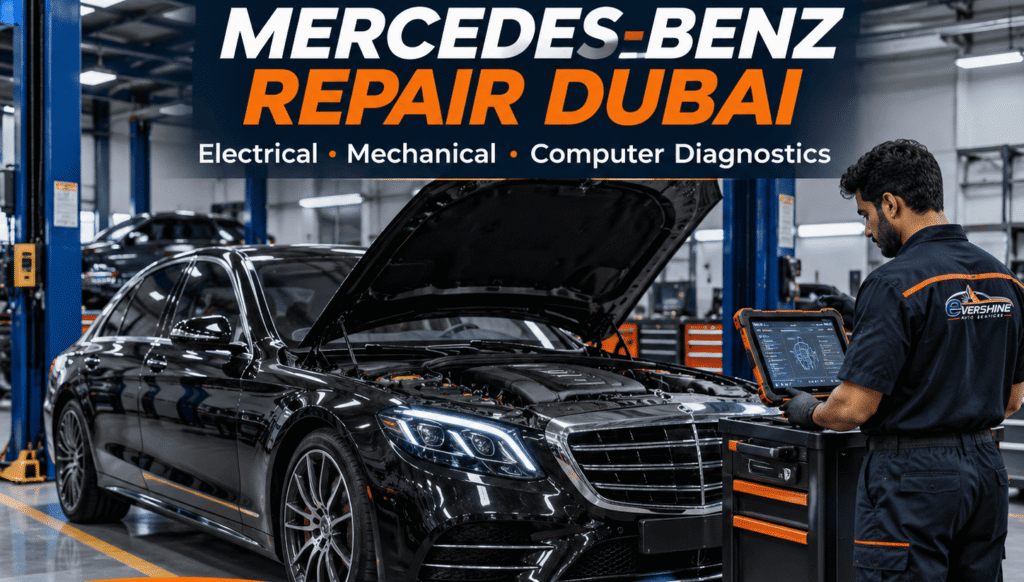
You start your Mercedes and a message appears in the instrument cluster. Maybe it’s about the battery, maybe the suspension, maybe just a yellow symbol you don’t recognise. The car drives the same as it did yesterday. So is it urgent, or can it wait until the weekend?
That uncertainty is one of the most common reasons Mercedes owners end up searching for Mercedes repair in Dubai. Modern Mercedes-Benz models are full of control units and sensors, and they report problems early, often before you can feel anything. That’s useful, but only if the message is understood correctly.
This guide explains the electrical and mechanical issues Mercedes owners commonly run into, what the warning signs usually point to, and why a proper diagnosis matters more than a quick guess.
Why a Mercedes Needs Careful Maintenance in Dubai
Mercedes-Benz doesn’t expect owners to service their cars on a fixed calendar alone. Many models use the ASSYST service system, which works out when service is due from time, distance and driving conditions, and shows it in the instrument cluster as Service A or Service B. Following those prompts, and your owner’s manual, is the starting point for any Mercedes maintenance in Dubai.
Local conditions add a few pressures of their own. Long summers keep the AC compressor and cooling system busy for months. Slow traffic means less air moving through the radiator and condenser. Fine dust clogs filters faster. Heat is also generally hard on batteries and on rubber parts like hoses, seals and air suspension components.
None of this means every Mercedes in Dubai will develop these faults. It does mean the systems below deserve closer attention than they might in a milder climate.
Electrical Problems: Where Most Modern Mercedes Issues Start
A modern Mercedes relies on its electrical system for far more than lights and the radio. Steering assistance, gear selection, braking aids, suspension control and the start/stop system all depend on stable voltage and on dozens of modules talking to each other. When the electrical supply is weak, the symptoms can look random.
Battery and alternator warning signs
The most common early signs are slow cranking, the engine taking longer to start, the ECO start/stop system no longer switching the engine off at lights, or several unrelated warnings appearing at once.
Many Mercedes models also have a small auxiliary battery alongside the main one. It supports the electronics during engine restarts so screens and controls don’t reset. If you see “Auxiliary Battery Malfunction”, start/stop may stop working. It’s often fine to drive for a short time, but if transmission or Park warnings appear as well, it should be checked straight away.
Battery problems aren’t always the battery itself. A failing alternator, a poor connection or a parasitic drain that empties the battery while the car is parked can produce the same symptoms. That’s why testing the whole charging system matters more than replacing the battery on suspicion.
Dashboard warning lights and electronic faults
Mercedes warning messages are colour-coded for a reason. Yellow messages generally mean the issue should be checked soon. Red messages mean stop safely and investigate before driving further. Either way, read the full message rather than just noticing the symbol, because the wording often narrows down the system involved.
A warning that disappears after a restart hasn’t necessarily gone away. The fault is usually still stored in the module’s memory, and intermittent faults are often the hardest to trace later if they’re ignored early.
Parking sensors, ABS sensors and wiring issues
Parking sensors that beep constantly, or not at all, are often affected by dirt, moisture or damaged wiring rather than a failed sensor. ABS and wheel-speed sensor faults are more serious, because the same sensors feed the ABS, stability control and sometimes cruise control. A single faulty sensor or damaged cable can switch several of these systems off at once, with warnings for each.
Wiring faults deserve a special mention. Chafed cables, corroded connectors and damaged harnesses can create symptoms that look like a failed component. Replacing parts without checking the wiring is one of the most common ways repair bills grow without fixing the problem.
Mercedes Air Suspension Problems and Warning Signs
Many Mercedes models, particularly the S-Class, E-Class, GLE, GLS and others with AIRMATIC, use air suspension instead of conventional springs. It gives a smooth ride and adjustable height, but it has its own set of warning signs.
Watch for one corner of the car sitting lower than the others after it has been parked overnight, the compressor running for long periods, a harsher or uneven ride, or messages such as “AIRMATIC Visit Workshop”. A red “Stop Vehicle Too Low” message is the serious one, and the car generally shouldn’t be driven.
The usual causes are air leaks from worn strut seals, cracked air lines or leaking fittings. A frequently misunderstood point is the compressor. It often fails because it’s been working overtime to make up for a leak elsewhere, so replacing only the compressor without finding the leak can lead to the same failure again. Faulty level sensors can also trigger warnings even when the car is sitting at the correct height.
Mechanical Issues to Keep an Eye On
Brake system wear
Squealing, grinding, a vibrating steering wheel under braking or a longer stopping distance all point to brake wear or a brake-system problem. Many Mercedes models have pad-wear sensors that trigger a warning when pads are getting low. Brake fluid also absorbs moisture over time and needs changing as part of scheduled maintenance, which is why it’s included in Mercedes’ own service items.
Engine and cooling system concerns
A rising temperature gauge, a coolant warning, a sweet smell after driving or coolant drips under the car all need prompt attention. Possible causes include leaking hoses or radiators, a failing water pump or thermostat, or a cooling fan that isn’t working properly. Oil leaks from ageing gaskets and seals are also common on older engines, and they’re usually simpler to deal with early.
If the engine overheats, pull over somewhere safe and switch it off. Never open the coolant reservoir cap while the engine is hot. The system is pressurised and hot coolant can cause serious burns.
Transmission and gearbox servicing
Mercedes automatic gearboxes depend heavily on the condition of their fluid and on their electronic control. Harsh or delayed shifts, slipping, a “limp” mode that limits gear selection, or a transmission warning in the cluster should be checked early. Fluid service requirements vary by gearbox and model, so check what applies to your car instead of assuming it never needs attention.
How Computerized Diagnostics Help
A proper diagnostic check starts with a scan tool that can read Mercedes-Benz control modules, not just a generic engine code reader. The fault codes it retrieves point to the system involved, such as a sensor circuit, a voltage problem or a communication fault between modules.
But codes are clues, not a final diagnosis. A wheel-speed sensor code could mean a failed sensor, damaged wiring, a corroded connector or a problem with the wheel bearing it reads from. Live data, component tests and physical checks are what confirm the real cause.
This is where good Mercedes diagnostics in Dubai save money. Fixing the right part the first time costs less than replacing several likely parts in sequence.
What Happens During a Professional Mercedes Inspection
A thorough inspection usually follows a sensible order. The technician talks to you about the symptoms and when they occur, scans the car’s modules and records stored faults, and checks battery and charging system health. Fluids, brakes, suspension, tyres and visible leaks are then inspected. A road test is often used to reproduce the fault, especially for transmission, suspension or intermittent electrical issues.
At the end, you should get a clear explanation of what was found, what needs attention now and what can wait.
How to Choose an Independent Mercedes Repair Workshop in Dubai
Many owners use independent Mercedes garages in Dubai once their car is out of warranty, or simply for more flexibility. A few practical checks help you choose well:
- Diagnostic capability. Ask whether the workshop can read Mercedes-specific modules and carry out related coding or adaptations where needed.
- Experience with your model. Different generations and engines have different known issues.
- Diagnosis before parts. A good workshop explains how it confirmed the fault before recommending replacements.
- Clear, written estimates. You should know the cost before work starts and get a call before anything is added.
- Transparency on parts and warranty. Ask whether parts are genuine, OEM or aftermarket, and what warranty covers the work.
Getting Your Mercedes Checked
Most expensive Mercedes repairs start as small warnings: a battery message, a car sitting slightly low in the morning, a brake squeal or a slower gear change. Paying attention early, and getting a proper diagnosis rather than a guess, usually keeps repairs simpler.
Ever Shine Auto Services is an independent workshop in Ras Al Khor Industrial Area 3, within easy reach for owners in Deira, Karama, Satwa and other parts of Dubai. If your car is showing warning messages or behaving differently, you can find out more about its Mercedes-Benz repair services in Dubai, or call the team on +971 50 176 8346 to arrange an inspection.