
It’s seven in the morning and you’ve just walked down to your car in the building’s open parking. There’s already a fine beige film across the bonnet. You run a tissue over the windscreen, get in, and drive to work, where the car then sits for eight hours in a lot with no shade to speak of. By evening it looks dusty, but otherwise fine.
That’s the trap. A car in Dubai can look perfectly acceptable and still be ageing faster than it should. Heat, sunlight and fine desert dust do their damage in layers too thin to notice from one week to the next. Then one day the paint looks flat under the petrol station lights, or the dashboard has a pale patch that won’t wipe off.
Below is what’s actually happening to your car, what you can handle yourself, and where professional car detailing in Dubai genuinely earns its cost.
Why Dubai Is Hard on Your Car
The problem isn’t simply the heat. It’s the combination of stresses, arriving every single day.
Heat. Coastal cities like Dubai and Abu Dhabi routinely post summer highs in the mid-40s °C, while inland parts of the UAE have crossed 50 °C in recent summers, according to the National Centre of Meteorology. Dark body panels in direct sun run far hotter than the air around them, and the cabin of a parked car can go past 70 °C in peak summer.
UV. UV index readings in the UAE regularly reach the “extreme” band, and the strongest months run roughly from March to September. Sunlight is what slowly breaks down paint, plastics and upholstery. Heat speeds the process up.
Dust and sand. Blowing dust is a normal part of life here, and the NCM issues regular alerts when winds pick up sand and reduce visibility. This isn’t soft household dust. It’s fine mineral grit, and it’s abrasive.
Humidity. Summer nights along the coast are often humid enough to leave dew on your car. Dew and dust together form a muddy film that dries into streaks and spots by mid-morning.
Everything else. Sprinkler overspray near parking bays, AC condensate dripping in basement car parks, bird droppings, tree sap, brake dust and the grey traffic film you pick up on Sheikh Zayed Road or Emirates Road.
Any one of these is manageable. Together, day after day, they wear a car down.
What Dubai Heat and UV Can Do to Your Car’s Exterior
Most modern cars have a colour layer (the base coat) protected by a transparent clear coat. The clear coat takes the beating, and when it weakens, everything underneath follows.
- Fading and oxidation. Prolonged UV exposure breaks down the clear coat and pigments. Some colours, reds in particular, tend to show fading sooner.
- Loss of gloss. Paint looks dull when its surface is no longer smooth, whether from contamination, fine scratches or early oxidation.
- Clear-coat failure. Once the clear coat starts to peel or turn cloudy in patches, polishing won’t fix it. That panel needs repainting.
- Water spots. When water evaporates it leaves minerals behind. In strong heat this happens fast, and if spots are left to bake in, they can etch into the clear coat.
- Bonded contamination. Iron particles from brake dust, tar and industrial fallout stick to the paint. After a wash, the surface feels rough rather than glassy.
- Swirl marks. Fine circular scratches you mainly notice in direct sunlight or under strong lights. More on these next.
Exterior plastics and rubber trims suffer too, gradually fading from black to a chalky grey.
Why Dust Can Be More Harmful Than It Looks
Here’s where things get interesting. Much of the swirling you see on Dubai cars isn’t caused by the desert itself. It’s caused by the way people remove the dust.
Dragging a dry cloth, a tissue or a feather duster across dusty paint pushes those mineral particles along the surface. Each pass leaves tiny scratches in the clear coat. Individually they’re invisible. After a few months of daily wiping, they show up as a spider-web haze whenever the sun hits the car.
The quick daily wipe offered in many residential buildings is convenient, and it isn’t automatically a problem. But if it’s done with a dry or reused cloth on a heavily dusty car, the effect on the paint is much like very fine sandpaper.
A safer approach:
- Rinse or pre-soak first so loose dust lifts off before anything touches the paint.
- Use a pH-neutral car shampoo and a clean wash mitt, not household detergent.
- Use two buckets, one with soapy water and one to rinse the mitt, so grit doesn’t go back onto the car.
- Wash from the top down. The lower panels carry the most grit.
- Dry with a clean, plush microfiber drying towel, patting or gliding rather than scrubbing.
- Waterless wash sprays are fine for a light layer of dust, used with plenty of clean microfiber towels. On a heavily dusty car, rinse instead.
Your Car’s Interior Is Also Taking a Beating
It’s easy to focus on paint because that’s what people see. Yet the cabin often ages faster.
The dashboard sits directly under the windscreen and takes the most concentrated sunlight in the car. Over time, plastics can fade, discolour and, on older or heavily exposed cars, crack.
Leather and synthetic leather dry out in heat. Without regular cleaning and conditioning, leather can stiffen and crack, especially on the driver’s seat bolster where you slide in and out. Some soft-touch plastics and buttons can turn sticky after years of sun exposure.
Dust gets in through door seals, vents and on your clothes and shoes. It settles into stitching, air vents, seat rails and carpet fibres, and clogs the cabin air filter faster than in milder climates.
Odours get worse in heat. Spilled coffee, food crumbs, sweat and damp sand from a beach day all break down faster in a hot cabin, and the smell tends to linger in fabric and carpet.
Two simple defences help a lot: a windscreen sunshade whenever you park outside, and good-quality window tint. UAE rules currently allow tint of up to 50% on eligible windows, with the front windscreen excluded, so check the latest RTA requirements before fitting.
Car Wash vs Professional Car Detailing: What’s the Difference?
A regular car wash and professional detailing aren’t competing services. They do different jobs.
| Regular car wash | Professional car detailing | |
|---|---|---|
| Main goal | Remove surface dirt and dust | Deep clean, restore and protect |
| Typical time | Minutes | Several hours to a full day or more |
| Paint contamination | Loose dirt only | Bonded contamination removed (iron, tar, clay treatment) |
| Swirls and dull paint | Not addressed | Can be reduced with machine polishing |
| Interior | Quick vacuum and wipe, if included | Detailed cleaning of seats, carpets, vents, trims and leather |
| Protection | Sometimes a spray wax | Sealant, ceramic coating or paint protection film, if chosen |
| Best for | Regular upkeep between details | Periodic reset and long-term protection |
For Dubai drivers, both have a place. A good wash every week or two keeps dust from building up. A detail every few months deals with everything a wash can’t reach and puts protection back on the paint.
How Professional Car Detailing Helps Protect a Vehicle
A proper detail is a sequence of steps, and not every car needs all of them. A good detailer inspects the car first and recommends what it actually needs.
Exterior deep cleaning and decontamination
This usually starts with a thorough pre-wash to soften and lift dust, followed by a careful hand wash and cleaning of wheels, arches and door shuts. Then comes decontamination: an iron remover dissolves brake-dust particles, and a clay bar or clay mitt pulls out bonded contamination. After this step, the paint should feel smooth to the touch.
Paint polishing and correction
Polishing removes an extremely thin layer of clear coat to level out swirls, light scratches and minor water-spot etching. It’s what brings back depth and gloss. It also has limits: clear coat is thin and can only be polished so many times, deep scratches through to the base coat won’t polish out, and failed or peeling clear coat needs repainting.
Interior deep cleaning
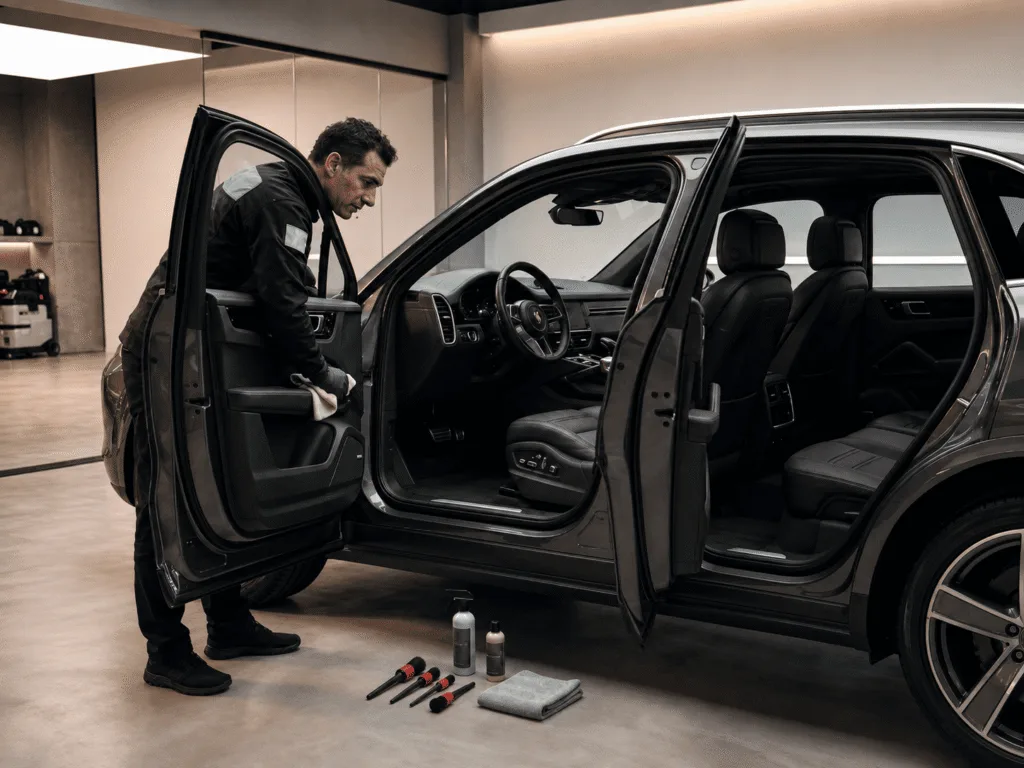
This covers detailed vacuuming, cleaning vents and seat rails, shampooing or extracting fabric seats and carpets, cleaning and conditioning leather, and applying a UV-protective dressing to dashboard and trim plastics. It’s often the part that makes the biggest difference to how a car feels to drive every day.
Paint protection
Once the paint is clean and corrected, it needs a protective layer:
- Wax or sealant offers basic protection and gloss for weeks to a few months.
- Ceramic coating forms a harder, longer-lasting layer that resists chemicals and UV and makes dust and water release more easily, so washing is quicker and safer. It is not scratch-proof, and it still needs correct washing. How long it lasts depends on the product and how the car is maintained.
- Paint protection film (PPF) is a clear, physical film that absorbs stone chips and light scratches, which is useful for highway commuting. Many modern films can self-heal light swirl marks with heat.
Be realistic about what any of these can do. No coating or film makes a car immune to Dubai’s climate. What they do is give the sun, dust and contaminants something to wear down other than your paint, and make regular cleaning much easier.
How Often Should You Detail a Car in Dubai?
There’s no single right number, because two cars in the same city can live very different lives. The factors that matter most:
- Parking. Open-air parking ages a car much faster than a basement or covered bay.
- Driving. A daily commuter on dusty roads collects more than a weekend car.
- Colour. Dark colours show swirls, dust and water spots more clearly and get hotter in the sun.
- Environment. Parking near construction sites, open desert or sprinklers adds to the load.
- Age and condition. Older paint and interiors may need more frequent care.
- Interior use. Kids, pets, beach and desert trips all mean more cleaning.
As a rough starting point, and not a fixed rule: a daily-driven car parked outdoors often benefits from a full detail every three to four months. A car in covered parking with moderate use may be fine every four to six months. A garaged weekend car might only need one or two a year. If your car has a ceramic coating, follow the maintenance schedule your installer gives you.
Simple Car-Care Habits Dubai Drivers Can Follow
Most long-term damage comes down to small everyday habits. These make a real difference:
- Don’t dry-wipe dusty paint. Rinse or use a proper waterless wash spray on light dust only.
- Wash in the shade, early or late in the day. If a panel is too hot to rest your hand on, it’s too hot to wash. Soap and water dry on hot paint before you can rinse, leaving spots.
- Remove bird droppings quickly. Soften them with a quick-detail spray or water, then lift them off gently rather than scrubbing. Heat makes their acidity more damaging the longer they sit.
- Look after your microfiber. Keep separate towels for paint, wheels and interior. Wash them without fabric softener and throw out any that feel stiff or gritty.
- Use a windscreen sunshade every time you park outdoors, and park facing away from the sun when you can.
- Shake out the floor mats regularly, especially after beach or desert trips, before the sand works deeper into the carpet.
- Don’t leave heat-sensitive items in the car. Aerosols, perfumes, power banks and lighters should not sit in a hot cabin.
- Follow your manufacturer’s maintenance schedule, including cabin air filter changes. In dusty conditions, check it more often.
When Should You Consider Professional Car Detailing?
A wash is enough most of the time. These are signs your car needs more than that:
- The paint looks dull even straight after washing.
- Water spots don’t come off with a normal wash.
- The paint feels rough or gritty when you run the back of your hand over it (inside a thin plastic bag, the texture becomes obvious).
- Swirl marks are clearly visible in direct sunlight.
- The interior has stains, lingering odours or dust packed into vents and stitching.
- Leather looks dry, faded or is starting to crease.
- The car is parked outdoors most days and hasn’t had protection applied in a long time.
- You’re preparing to sell. A properly detailed car photographs better and gives buyers fewer reasons to negotiate.
Final Thoughts
Dubai’s climate doesn’t wreck cars overnight. It works slowly, through UV breaking down the clear coat, heat baking contaminants into paint and cabin materials, and fine dust turning every careless wipe into a scratch. The good news is that most of this is preventable with the right habits, a safe washing routine and an occasional professional reset.
If your car is showing some of the signs above, or you simply want to get protection on it before the next summer, Evershine Cars offers full car detailing in Dubai from its workshop in Ras Al Khor, along with ceramic coating, paint protection film and window tinting. You can see what’s included on the car detailing Dubai page and ask the team which options suit your car and how you use it.
Frequently Asked Questions
How often should I detail my car in Dubai?
It depends on how and where the car is kept. A daily driver parked outdoors often benefits from a full detail every three to four months, while a car in covered parking may go four to six months. Regular washing in between matters just as much.
Is car detailing different from a car wash?
Yes. A car wash removes surface dirt. Detailing goes further: removing bonded contamination, correcting paint defects where needed, deep cleaning the interior and applying protection.
Does Dubai heat damage car paint?
Heat on its own speeds up damage rather than causing all of it. The main culprit is prolonged UV exposure, which breaks down the clear coat over time. Heat then makes water spots, bird droppings and other contaminants more damaging the longer they sit on the paint.
Can detailing remove water spots?
Fresh surface spots can usually be removed with the right cleaning products. Spots that have etched into the clear coat often need machine polishing. Very deep etching may not come out completely.
Is interior detailing necessary in Dubai?
It isn’t mandatory, but it’s worthwhile. Dust, heat and UV affect the cabin constantly, and interior detailing removes packed-in dust, treats leather, and applies UV protection to plastics that sit under direct sun every day.
Does ceramic coating help with Dubai dust and heat?
It helps, within limits. A ceramic coating adds a durable layer that resists UV and chemical contamination, and it makes dust and water release more easily so washing is quicker and safer. It won’t stop scratches from dry-wiping or stone chips, and it still needs regular, correct washing.
How long does professional car detailing take?
A standard interior and exterior detail typically takes several hours. Jobs that include paint correction or ceramic coating can take a full day or longer, depending on the car’s size and condition, and coatings may need extra curing time before the car can be washed.