
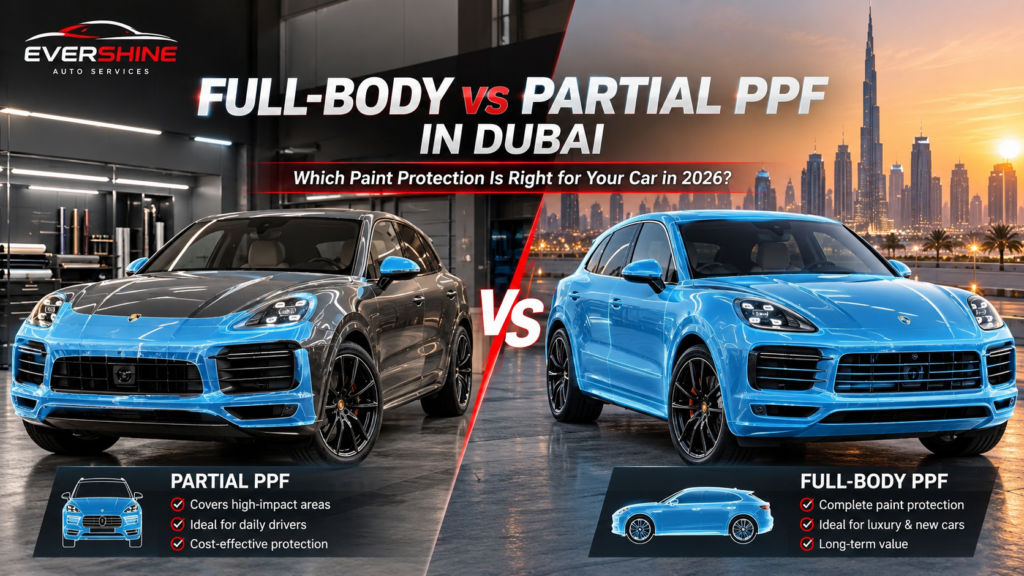
Spend a week driving in Dubai and your car’s front end tells the story. A few new chips on the bonnet after a run down Sheikh Zayed Road. A scuff on the bumper from a tight mall car park. A fine haze of sand settling on every panel. It is no surprise that more Dubai car owners are looking at paint protection film (PPF) before the first chip appears rather than after.
But for most owners, the real question is not “Should I get PPF?” It is “How much of my car actually needs PPF?”
Covering the whole car and covering only the most exposed areas are two very different decisions, with different costs and different benefits. The right answer depends on a handful of practical factors:
- Driving habits — short city trips versus long daily commutes
- Highway usage — how often you drive at speed behind other vehicles
- Vehicle value — and how much it would cost to repaint or match the paint
- Parking environment — covered villa parking versus crowded open lots
- Ownership plans — whether you will keep the car for two years or eight
- Budget — what you are comfortable spending now to avoid costs later
- How much original paint matters to you — for resale or personal satisfaction
This guide explains what PPF does (and does not do), how partial and full-body coverage compare, and how to decide which option makes sense for the way you actually use your car.
What Is Paint Protection Film (PPF)?
Paint protection film is a clear, flexible film, typically made from thermoplastic polyurethane (TPU), that is applied directly over a car’s painted surfaces. Once installed, it sits between your factory paint and the outside world as a sacrificial physical layer. When something hits the car, the film takes the impact and wear first.
How it is installed. A proper installation starts with a thorough wash and decontamination to remove bonded particles and residue. Many installers recommend paint correction or car polishing beforehand, because the film locks in whatever condition the paint is in. The film is then cut to fit each panel (pre-cut patterns or hand-trimmed), positioned using a slip solution, and squeegeed down so it bonds evenly. Edges are wrapped or finished cleanly so the film is hard to notice.
What PPF can help protect against:
- Stone chips and small road debris thrown up at speed
- Sand abrasion and light surface wear
- Minor scuffs and light scratches from daily use
- Wash-induced swirl marks (many modern films have a self-healing top coat that helps light marks fade with heat)
- Some environmental contaminants, such as bird droppings and insect residue, if cleaned off reasonably promptly
What PPF cannot protect against:
- Collisions, dents or heavy impacts
- Deep scratches, key marks or vandalism that cut through the film
- Large debris or rocks that can damage panels underneath
- Damage to unprotected areas — the film only protects where it is applied
- Poor-quality installation, which can lead to lifting edges, bubbles or visible seams
In short, PPF is designed to reduce specific types of physical paint damage. It does not make a vehicle scratch-proof or damage-proof, and any installer who suggests otherwise is overselling it.
Why PPF Makes Sense for Dubai Driving Conditions
Dubai’s roads are generally well maintained, but the way cars are used here creates steady, everyday exposure that adds up over time.
Highway road debris. Many residents drive regularly on Sheikh Zayed Road, Al Khail Road, Emirates Road and other major routes. At highway speeds, small stones and grit kicked up by the vehicle ahead hit the bumper, bonnet, mirrors and headlights with real force. Construction zones and heavy-vehicle traffic add to this.
Sand and fine dust. Windblown sand settles on cars daily and becomes airborne during dusty or windy days. Driving through it, or wiping a dusty car with a dry cloth, can cause fine abrasion. Over months, this dulls the clear coat.
Stone chips. A chip that breaks through to primer or metal is more than cosmetic. Touch-ups rarely look perfect, and respraying a bonnet means losing factory paint on that panel.
Parking-area scuffs. Busy mall car parks, tight residential spaces and older neighbourhoods with close street parking mean door edges, bumper corners and lower panels pick up knocks and rubs.
Sunlight and heat. Dubai’s strong sun and high summer temperatures put constant stress on exterior finishes. Quality PPF is generally UV-stable and helps shield the paint underneath, but the film itself is also exposed, which is why film quality and aftercare matter.
None of this means every car in Dubai needs full coverage. It does mean that front-facing and lower panels see consistent wear, and that is the starting point for deciding how much of your car to protect.
Partial PPF vs Full-Body PPF: What’s the Difference?
Partial (often called front-end) PPF protects the panels that take the most direct hits. Full-body PPF covers every painted exterior panel. Here is how they compare in practice:
| Factor | Partial / Front-End PPF | Full-Body PPF |
| Coverage | High-impact areas: typically front bumper, bonnet (full or partial), front fenders and mirrors | All painted exterior panels, including doors, roof, rear bumper, quarter panels and pillars |
| Best suited for | Daily drivers, city-focused use, owners mainly worried about front-end chips | New, luxury or high-value cars; long-term owners; frequent highway drivers |
| Main advantages | Lower cost; protects where most chips happen; shorter installation time | Broad, consistent protection; no visible film line on panels; preserves factory paint across the whole car |
| Limitations | Sides, rear and roof remain exposed; a film edge may be visible on partially covered panels | Significantly higher cost; longer installation; more film to maintain |
| Typical use case | A family SUV or sedan used for school runs, office commutes and weekend errands | A new luxury SUV or performance car driven regularly on major highways and kept for several years |
| Budget consideration | Entry-level investment in paint protection | Premium investment; cost varies with vehicle size and body complexity |
| Maintenance considerations | Protected and unprotected areas may age differently; unprotected panels still need regular care | Uniform surface is easier to care for consistently; the whole film needs correct washing and periodic inspection |
Exact panel coverage varies by installer and by vehicle shape, so always confirm which panels, and how much of each, are included before booking.
What Areas Are Usually Covered With Partial PPF?
Partial packages focus on the surfaces most likely to be hit, chipped or scuffed. Common areas include:
- Front bumper — the single most exposed panel on most cars, taking direct hits from debris at speed.
- Bonnet/hood — either the full bonnet or a leading section (often around 30–60 cm). Full-bonnet coverage avoids a visible film line across the panel.
- Front fenders — partially or fully, since debris often strikes them at an angle.
- Side mirrors — they stick out into the airflow and are easily chipped or scuffed.
- Headlights — where applicable, to help reduce pitting and haze on the lenses.
- Door edges and door cups — areas behind handles that collect fingernail scratches and parking knocks.
- Other high-impact areas — rocker panels, the leading edge of the roof, A-pillars, rear bumper loading area or the area behind the wheels on some vehicles.
Packages vary between installers and vehicles. A sloping sports-car bonnet and a flat SUV front present different risks, so a good installer will look at your actual car and driving pattern before suggesting coverage.
Who Should Consider Partial PPF?
Partial PPF is a practical choice for many Dubai drivers. It tends to suit you if:
- Your car is a daily driver and you want sensible protection without a premium spend.
- You mostly drive in the city, with shorter trips and lower average speeds.
- You are working within a budget and want the most protection per dirham.
- Your main concern is front-end stone chips rather than the overall finish of every panel.
- Your car spends little time on highways, so side and rear panels see less debris.
- You plan to sell or change the car in a few years and mainly want the front end to look clean at resale.
If your car is already a few years old with some existing wear, partial coverage on freshly polished front panels can also be a sensible middle ground.
Who Should Consider Full-Body PPF?
Full-body PPF is not necessary for everyone. It makes the most sense when the cost of paint damage, or the value of original paint, is high for you. Consider it if:
- The car is new, so you can protect factory paint before any damage occurs.
- It is a luxury or high-value vehicle, where repainting panels is expensive and can affect resale.
- You plan to keep the car long-term, giving the film more years to earn back its cost.
- You drive frequently on highways, where debris can reach doors, mirrors and lower panels, not just the front.
- You want broader protection against door dings, parking scuffs and wash marks on every panel.
- The factory paint is expensive or difficult to match, such as matte, tri-coat, pearl or special-order colours.
For matte or satin paint, many owners consider matte-finish PPF, because these finishes cannot simply be polished out if damaged.
Full-Body vs Partial PPF: Which One Offers Better Value?
Value is not the same as the lowest price. The better-value option is the one that matches your real risk exposure. Paying for full-body film on a car that rarely leaves the neighbourhood is poor value. So is covering only the bumper on a new luxury SUV that spends hours on the highway every week and later needs its doors and bonnet resprayed.
A practical way to decide is to ask four questions:
- Where does damage on my car actually happen? Look at your current or previous car. Are the chips only at the front, or along the sides and lower panels too?
- What would a repaint cost, and how would it affect resale? The more expensive or harder-to-match the paint, the stronger the case for broader coverage.
- How long will I keep the car? Longer ownership spreads the cost of PPF over more years of protection.
- What would bother me most? Some owners only care about avoiding visible chips at the front. Others want the entire car to stay as close to factory condition as possible.
A simple decision guide
- If you mainly drive in the city → Partial or front-end PPF is usually enough, focused on the bumper, bonnet, fenders and mirrors.
- If you drive on highways most days → Consider an extended front package at minimum (full bonnet, full fenders, mirrors, headlights), or full-body if the car is new or high-value.
- If your car is new and you plan to keep it for many years → Full-body PPF offers the most consistent long-term protection for factory paint.
- If you drive a luxury car or have special paint (matte, tri-coat, rare colour) → Full-body coverage is worth serious consideration.
- If you park in crowded open lots or on the street → Add door edges, door cups and the rear bumper loading area, even to a partial package.
- If budget is your main constraint → Start with front-end PPF and add ceramic or graphene coating to the rest of the car for easier cleaning and gloss.
- If you plan to sell within a year or two → Partial PPF on the front end usually gives the most visible return.
PPF vs Ceramic or Graphene Coating: Do You Need Both?
PPF and coatings are often compared, but they do different jobs. PPF is a physical film that absorbs impacts and abrasion. A ceramic coating or graphene coating is a thin liquid-applied layer that adds gloss, makes the surface more water- and dirt-repellent, and makes washing easier. A coating cannot stop a stone chip.
Many Dubai owners combine the two in one of these ways:
- Front-end PPF + coating on the rest of the car — impact protection where it matters most, easier cleaning everywhere.
- Full-body PPF + coating on top of the film — the coating helps the film shed sand and dust and stay easier to clean.
- Coating only — suitable for owners mainly focused on gloss and easy maintenance, accepting that chips are not prevented.
What Affects PPF Cost in Dubai?
PPF pricing is quoted per vehicle rather than as a fixed rate, because several factors change the job:
- Coverage — front-end, extended front or full-body.
- Vehicle size and shape — a large SUV needs more film and labour than a compact hatchback; complex bumpers and vents take longer.
- Paint condition — cars needing paint correction before installation cost more to prepare.
- Film type and finish — gloss versus matte, and the film’s grade and warranty terms.
- Installation method — pre-cut patterns versus custom trimming and wrapped edges.
The most reliable approach is to get a quote based on an inspection of your actual car, and to ask exactly which panels, film and warranty terms are included.
PPF Aftercare in Dubai
Good aftercare helps the film look its best for longer:
- Avoid washing the car for the first few days after installation, or follow your installer’s specific curing advice.
- Rinse off sand and dust before wiping; never dry-wipe a dusty car.
- Use a pH-neutral shampoo and soft microfibre mitts.
- Avoid aiming a pressure washer directly at film edges at close range.
- Remove bird droppings, insects and tree sap promptly.
- Park in shade or covered parking where possible.
- Have the film inspected periodically for lifting edges or damage.
Frequently Asked Questions
Is full-body PPF worth it in Dubai?
It can be for new, high-value or long-term vehicles that spend a lot of time on highways. For city-based daily drivers, partial PPF often provides the most practical value.
Can I start with partial PPF and add more coverage later?
Yes. Many owners begin with front-end coverage and extend it later. It is easiest when the remaining paint is still in good condition.
Does PPF change how my car looks?
Quality gloss PPF is designed to be nearly invisible when properly installed. Matte PPF changes a gloss finish to satin, which some owners choose deliberately.
Will PPF stop all scratches?
No. It helps reduce stone chips, light scratches and scuffs, and many films can self-heal light marks. Deep scratches, collisions and vandalism can still cause damage.
Should I polish my car before PPF?
If the paint has swirls or light defects, polishing beforehand is recommended because the film will seal in whatever is underneath.
Final Thoughts: Choose Coverage Based on How You Drive
There is no single right answer to full-body vs partial PPF in Dubai. City drivers on a budget will often get excellent value from front-end coverage. Frequent highway drivers, owners of new or high-value cars, and anyone planning long-term ownership have a stronger case for full-body protection. Many people land in between, combining front-end PPF with a ceramic or graphene coating.
The best next step is an honest inspection of your car and a conversation about how you actually use it. Ever Shine Auto Services offers both front-end and full-body PPF installation in Dubai from its Ras Al Khor workshop, with coverage and pricing based on your vehicle’s size and condition.