
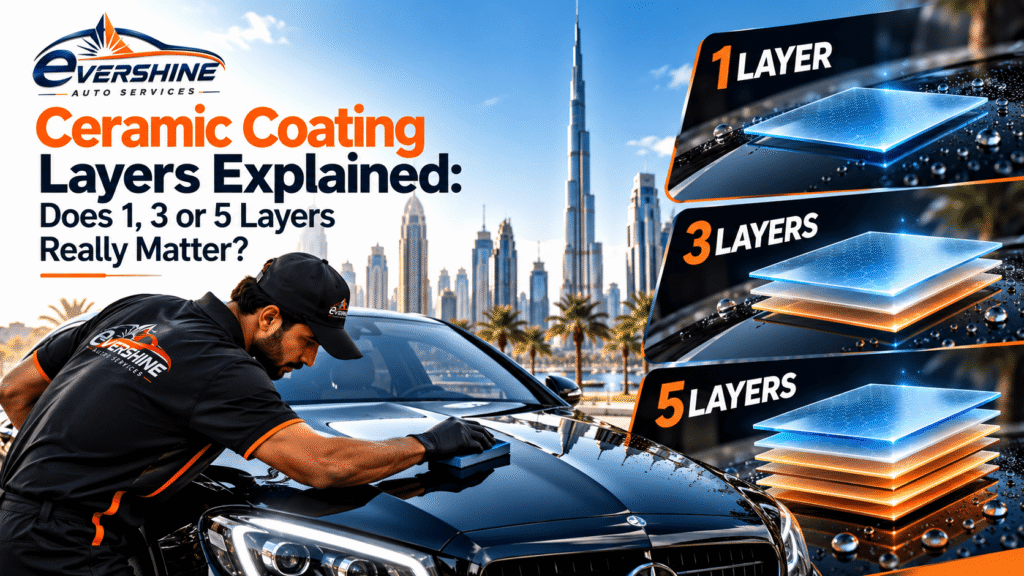
Ask around for ceramic coating quotes in Dubai and you’ll quickly notice that layers have become a selling point. One package offers a single layer. Another offers three. A premium option promises five or more, often with a longer warranty attached. The natural assumption is that more layers means more protection.
Sometimes that’s partly true. Often it isn’t. The number of layers is one of the least reliable ways to compare coating packages, and it can distract from the things that actually decide how well a coating performs.
Here’s what a “layer” really is, when extra layers help, when they don’t, and what to ask before you pay for them.
First, How Thin Is a Ceramic Coating?
This is the detail that changes how you think about layers.
Factory clear coat on most modern cars is roughly 30 to 50 microns thick. A ceramic coating layer is far thinner, commonly described as being in the region of a micron or two once cured. Even several layers together remain a tiny fraction of the clear coat underneath.
So adding layers doesn’t build anything like a thick shell over the paint. It adds a little more of a very thin film. That’s why multiple layers can’t turn a coating into impact protection, and why no number of layers will stop stone chips. That job belongs to paint protection film.
What “Layers” Can Actually Mean
When two installers say “three layers”, they may not be describing the same thing. The word gets used in at least three different ways.
Repeat coats of the same product. The installer applies a coating, lets it flash and level, then applies the same coating again. This is the simplest meaning.
A base coat and a top coat. Some coating systems are designed as two different products working together. A harder base layer bonds to the paint, and a top layer adds slickness and water repellency. Gtechniq’s Crystal Serum Light with EXOv5 on top is one well-known example. Here, “two layers” is the system working as designed, not an upgrade.
A package of separate coatings. Some packages count coatings on different surfaces, such as paint, wheels, glass or trim, in a broader description of the service. That’s useful work, but it isn’t the same as extra layers on your paint.
Before comparing quotes, ask the installer which of these they mean. It often explains most of the price difference.
When an Extra Layer Genuinely Helps
There are good reasons to apply more than one layer, as long as the product is designed for it.
More consistent coverage. Hand-applied coatings can go on slightly unevenly. A second coat helps fill any thin or missed spots, especially on complex shapes like bumpers, mirrors and door edges.
A small boost in durability. A slightly thicker cured film can last somewhat longer, particularly on high-wear areas such as the bonnet, roof and lower panels, which take the most sun and the most washing.
Completing a designed system. If the product is a base-and-top-coat system, both layers are part of the intended result. Skipping one means you don’t get what the product was designed to deliver.
Extra attention for high-exposure areas. Some installers apply an additional coat only on horizontal panels, where UV and dust are most intense. That can be a sensible use of time and product.
Where More Layers Stop Adding Much
Here’s where things get interesting. Even coating suppliers who recommend layering tend to say the gains get smaller after the second layer.
There are practical reasons for this:
- Each layer bonds to the one beneath it, not to the paint. Past a point, you’re adding material to material, with limited extra benefit.
- Many coatings are formulated as single-layer products. Stacking them may add little, and some manufacturers don’t recommend it at all.
- Durability depends on more than thickness. How the coating is washed and maintained, and the conditions it lives in, matter far more than an extra coat or two.
None of this means a three-layer package is a bad idea. It means the jump from one or two layers to five or more is rarely worth paying a large premium for on the layer count alone.
When More Layers Can Actually Cause Problems
More layers also mean more chances for things to go wrong.
High spots. If excess coating isn’t levelled and wiped off at the right time, it cures as a dark, smeary patch. These often need to be polished off and reapplied. Every extra layer is another opportunity for this.
Rushed timing between layers. Coating systems specify a waiting time before the next layer goes on. Gtechniq, for example, suggests waiting around two hours between Crystal Serum Light and EXOv5. Cutting this short can affect how the layers bond.
Heat during application. In hot conditions, coatings can flash faster than intended, which makes them harder to level evenly. Applying in a controlled, shaded or indoor environment matters, and it matters even more when several layers are involved.
Mixing incompatible products. Layering two coatings that weren’t designed to work together can cause poor bonding or an uneven finish.
What Matters More Than the Number of Layers
If you’re comparing coating packages, these factors usually make a bigger difference to the result than how many layers are applied.
Paint preparation. A coating locks in whatever is under it. If the paint isn’t properly washed, decontaminated and corrected first, every swirl and water spot gets sealed in under a glossy film. Five layers on poorly prepared paint will look worse than one layer on properly corrected paint.
The product itself. Coatings vary widely in formulation and quality. One good professional coating can outperform several layers of a weaker product.
Application conditions and skill. Clean, temperature-controlled conditions and an experienced installer reduce high spots and uneven curing.
Curing time. Coatings need time to cure before getting wet or being washed. Gtechniq, for instance, advises keeping Crystal Serum Light indoors for 12 hours after application and not washing the car for at least a week. Your installer should give you clear instructions for the product used.
Aftercare. A coating that’s dry-wiped every morning or run through brush washes will wear faster than one that’s washed gently. In Dubai, where cars collect dust daily, the washing routine has a direct effect on how long any coating lasts.
So How Many Layers Should You Choose?
There’s no universal answer, but these situations are a reasonable guide:
| Situation | What usually makes sense |
| Daily driver, parked outdoors, kept for several years | A quality coating with one or two layers, or a base-and-top system, with an extra coat on horizontal panels if offered |
| Newer car you plan to keep long-term | Good paint preparation plus a two-layer or base-and-top system |
| Car kept in covered parking with moderate use | A single layer of a good coating is often enough |
| Leased car or one you’ll sell soon | A single-layer coating or a durable sealant |
| Car with swirls or faded paint | Paint correction first; the number of layers matters far less than the correction |
| Highway commuter worried about stone chips | Layers won’t help with chips; consider PPF on the front, with coating on the rest |
Questions to Ask Before You Book
A good installer will be happy to answer these clearly.
- Which coating product are you using, and is it designed to be layered?
- When you say “layers”, do you mean repeat coats of the same product, a base and top coat, or coatings on different surfaces?
- How long do you wait between layers, and where is the coating applied?
- What paint preparation is included before coating? Is machine polishing part of the price?
- Does the warranty depend on the number of layers, or on maintenance visits and washing methods?
- How long will the car need to cure before I can drive it or wash it?
If the answers are vague, or the only difference between packages is the layer count, it’s worth asking more questions before deciding.
Final Thoughts
Layers do matter, but less than most coating packages suggest. One or two layers of a good coating, or a well-designed base-and-top system, applied over properly prepared paint and cured correctly, will usually do more than several layers applied in a hurry. Prep, product quality and aftercare decide most of the result. The layer count decides a small part of it.
If you’re looking at ceramic coating for your own car, Evershine Cars offers ceramic coating in Dubai from its Ras Al Khor workshop. It’s worth asking the team which product and layer setup they’d recommend for your car, how it’s parked and how you plan to wash it.
Frequently Asked Questions
Is a 3-layer ceramic coating better than 1 layer?
It can offer more even coverage and slightly better durability, if the product is designed for layering. But a single layer of a good coating on well-prepared paint will often perform better than three layers on poorly prepared paint.
Do more ceramic coating layers mean more scratch protection?
Not in any meaningful way. Each layer is extremely thin, so even several layers can’t stop scratches or stone chips. For physical protection, paint protection film is the right product.
Why do some coatings come as a base coat and top coat?
The two products do different jobs. The base layer bonds to the paint and provides the main protection, while the top layer adds slickness and water repellency. In these systems, both layers are part of the intended result.
How long should you wait between ceramic coating layers?
It depends on the product. Some systems suggest waiting a couple of hours; others specify different times. The installer should follow the manufacturer’s instructions rather than a general rule.
Can I add another layer of ceramic coating later?
Often, yes, but the existing coating usually needs proper cleaning and preparation first, and the products need to be compatible. Ask your installer whether the coating you have can be topped up.
Does a 5-layer ceramic coating last five times longer?
No. Durability doesn’t increase in proportion to the number of layers. Paint preparation, the product, curing and how the car is washed all have a bigger effect on how long a coating lasts.